Article for: Artes de Mexico
Numero 141 November 2025
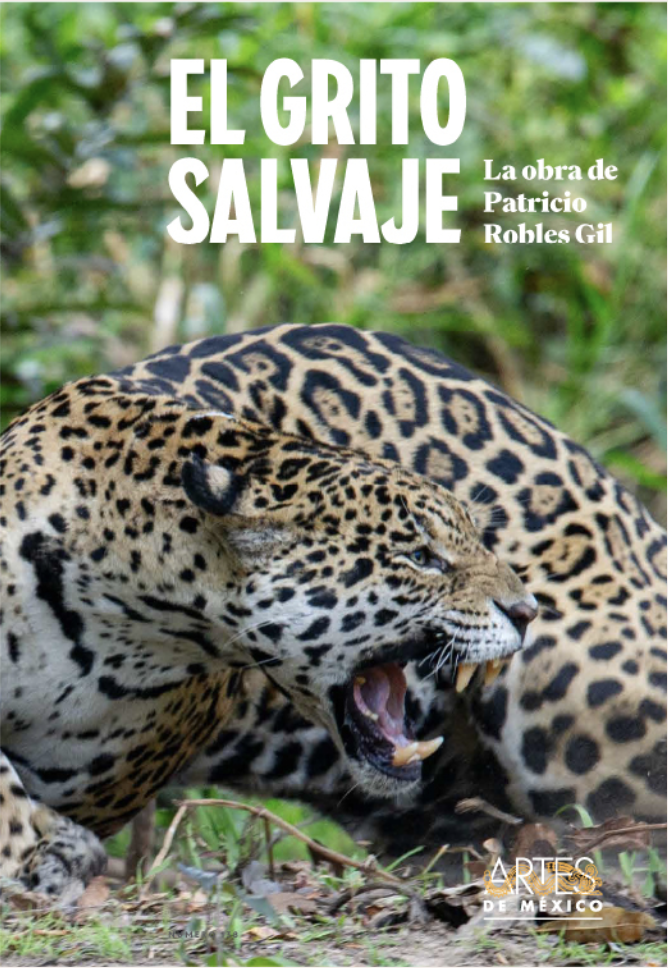
El Grito Salvaje La obra de Patricio Robles Gil
The Healing Cut
Impact is important. When we consider the state of our natural world, the impact of our work and of our personal choices has never been as important as it is today.
This reality is made more interesting by the fact that impact is a blade that can cut in opposite directions. The painful negative impact of our human assault on the environment continues to accelerate, cutting ever more deeply into the heart of nature -- climate, habitat loss, plastics, extinction, pervasive toxicity, increased human population…the list goes on. And this even though the opposite and most necessary impact -- the healing cut against the ever-thickening under-brush of destructive human mindsets, persistent social inequity and poverty, and overly consumptive personal lifestyles -- has yielded some new growth of emerging, positive change in environmental awareness and policy, and in specific, tactical solutions for nature protection.
In such increasingly dire circumstances, how is it even possible that an artist can positively impact nature conservation?
Patricio Robles Gil shows us how.
Patricio and I met in the African bush, where all meetings about wilderness should happen. It was just prior to the World Conservation Congress convened in South Africa in 2003, under the auspices of the World Commission on Protected Areas (WCPA) within the International Union for the Conservation of Nature (IUCN). I was founder President of the WILD Foundation, with strong roots in Southern Africa. I planned with local colleagues to acquaint my friend Russ Mittermeier, one of the most effective conservation biologists of our times, with this fabulous region. We visited several reserves, starting in Lesotho (Leh-su-too), the mountainous, independent kingdom completely encircled by South Africa. When we met, Russ had with him a tall, strong man…enter Mexican conservationist and photographer, Patricio Robles Gil. Patricio wanted to connect WILDs work and my global outreach.
There on the ‘roof of Southern Africa’ we searched the starkly beautiful landscape for the endemic and wonderfully strange golden mole by day, and by night we sat in the glowing ring of a campfire. In this ancient circle of power, knowledge, and communication, Patricio and I spoke of our mutual passion; our commitment to save wild nature and the strategies with which we worked. We discussed how nature conservation was too dominated by science and literal objectivity, and how we both firmly believed that ‘culture’ (art and communications) was an overlooked but vitally important element in creating truly effective and long-lasting conservation solutions.
At that time, with a collaborative global team, the WILD Foundation was organizing the 8th World Wilderness Congress (WILD8) to convene in Alaska in 2005, and I was deeply involved in planning a high-impact agenda. Around those campfires in Southern Africa, I was immediately intrigued with the story Patricio shared with me, of how in 1993 Don Lorenzo Zambrano, Chairman of CEMEX (at that time one of the world’s largest cement/building supply companies) asked for his help in defining the company’s lasting corporate commitment to the environment. They had discussed two aspects-- both were to develop into initiatives with major impact.
One was the CEMEX Nature Book Series. Patricio and Russ had worked together for several years to produce two of these most influential, large-format, conservation/art books. They were committed to a third book, one about ‘wilderness’, the core issue of my global conservation work. This series of books – produced annually to this day -- is seen in virtually every office of high-level politicians, senior scientists, and businessmen around the world, and is widely regarded as having had very significant legendary impact on global conservation as a whole, including creating new protected areas and promoting the flow of millions of US ‘conservation dollars’ to regions that were not previously considered a priority. For the first 15 books, Patricio was in charge as editor, selecting topics for each from among the world’s most consequential conservation issues, into which he brought the best, most readable scientific and conservation writing coupled with the power of the best available photographic imagery.
The other idea that Patricio discussed with Don Lorenzo was to acquire and protect in perpetuity the highly biodiverse area called El Carmen. Following our time in Southern Africa, Patricio asked CEMEX to invite Russ and me to visit and review the El Carmen project. There, from the top of the El Carmen escarpment, we could see this extensive, amazing landscape and its promise. The story of rewilding El Carmen was clearly globally important. The possibility of a Mega Transboundary Conservation Corridor between the Chisos Mountains in Big Bend National Park (Texas) - across the Rio Bravo/Rio Grande from us -- and the Sierra Maderas del Carmen Reserve, in Coahuila State (MX) was captivating, as was the wonderful irony of a cement company being the driving force of this pioneering, multi-layered, large scale conservation project.
It was clear that this initiative must be presented to the world, and WILD8 was the perfect forum to do it. I worked with Patricio to facilitate a delegation of CEMEX top executives, Mexican government officials and other involved conservation organizations, so the El Carmen story could be launched. It’s story was told, the methodology presented, as was the intention to declare an official wilderness area within El Carmen.
Much was accomplished during the El Carmen project. In addition to the intention to declare the wilderness area. Just two others (of many) were:
In 2004, a decade after Patricio presented the El Carmen concept to Don Lorenzo, in the second version of HOTSPOTS, the Madrean Pine-Oak Woodlands of El Carmen was recognized as a global biodiversity hotspot, one of those very special, specific regions around the world that contain the highest number of threatened and endangered species.
Through professional wildlife management and the reintroduction of extinct and keystone species such as desert bighorn sheep, North American elk, bison, and pronghorn antelope, El Carmen has become a Nature Reserve with eight species of North American mega-fauna. With planned, future re-introductions of three additional, missing large predators, the El Carmen Reserve will be comparable in this regard to the Greater Yellowstone Ecosystem.
With the success of the work at El Carmen and the global presentation at WILD8, Patricio and I considered that the natural next step was to convene the 9th World Wilderness Congress (WILD9) in Mexico in 2009. Patricio led the charge, and thus began the next, three-year saga of WWC planning for global wilderness progress (that so often included pain and frustration!). A few of the negative elements impacting our planning for this international event were: the global financial crash of 2008; the dramatic rise of the lethal activities of Mexican criminal cartels; the sudden spread of the deadly H1N1virus; and a debilitating accident suffered by Patricio while on expedition in far Western China, just nine months prior to WILD9.
There was no alternative but to power through these obstacles, and we persisted (with Patricio leading despite the very painful after-effects of his accident). This Congress has been described as the highest-impact conservation process ever conducted in Mexico. In November (2009), WILD9 hosted 1800 delegates from 50 countries on-site in Merida, Mexico, with over 12,000 additional on-line participants from 130 countries. Opened by President Felipe Calderon, WILD9 conveyed extraordinary hope and enthusiasm.
Practical outcomes were many, including:
CEMEX officially declared the El Diablo Cañon Wilderness Area. This wildest core of the 148,000 ha El Carmen conservation area owned or managed by CEMEX was a remote area in the northern region of El Carmen, and would be professionally managed as ‘wilderness’ under international standards (IUCN/WCPA Category 1b),
the launch of Nature Needs Half -- a science-based conclusion that we must protect half of the world’s lands and seas in order to sustain all life on earth -- an idea that today is embraced by the IUCN (the world’s leading and largest federation of environmental organizations and experts, and a United Nations advisor);
the first international agreement on wilderness (involving the US, Mexico and Canada);
new protected areas in the Yucatan and elsewhere; and
one of the most significant multi-cultural conservation art programs ever produced including, among many things, sculpture, painting, conservation photography and, especially, a multi-media project called Wild Rituals Painted Bodies.
Patricio often works by, in his words, “Thinking and acting ten steps ahead of others.” During WILD9 planning, Patricio had an idea that we took directly to Environmental Minister Juan Elvira Quesada. The Minister became excited by Patricio’s suggestion that Mexico revive the long-stalled, bi-lateral negotiations with the US to create an official conservation area between Texas and Mexico -- a ‘Peace Park’ concept originally suggested in the 1930s by US President Franklin Roosevelt to President of Mexico, Avila Camacho. As we spoke to the Minister his eyes brightened and he said, “I like this very much…let me try this.”
Minister Elvira took this to the President of Mexico, Juan Felipe Calderon, and to Ken Salazar, US Secretary of Environment. It is a fabulous story told best by Elvira and Salazer themselves, in which they cite Patricio, me and the World Wilderness Congress as the instigators of this “fine idea.” In May 2010, Presidents Calderon and Obama initiated the agreement to establish a 1.8 million ha “Natural Area of Bi-National Conservation Interest” (known informally as the Big Bend/El Carmen Complex), that was signed by Elvira and Salazar in October 2011 on the banks of the Rio Bravo/Rio Grande. As I accompanied the Ministers that day and watched the ceremony, I saw actualized what Russ and I experienced atop the El Carmen escarpment, when we viewed the possibility of a Transboundary Mega-Conservation Corridor -- that which Patricio had seen and strategized for more than a decade.
Following the major success of WILD9, Patricio seemed to end his highly visible and accomplished public conservation work. He withdrew from direct, inter-organizational conservation and closed the doors of his NGO, Sierra Madre. He needed to heal body and soul, including many operations to address the terrible injury he suffered in 2008 in the Pamir mountains of China on his search for wild goats and sheep. We didn’t communicate for several years. But even during this phase…that in hindsight was a pause rather than an end…he continued his intense exploration of the human/nature interface through sculpture, multi-media and, of course, photography.
In 2015, I was home in Colorado and received via courier an impressive book, encased in a hard shell, red cloth box, in large format (44 x 35 cm). “The Onças Pintadas of the Cuiaba River” was the result of Patricio’s submersion in field observation and documentation of the jaguars in the Brazilian Matto Grosso , produced from numerous expeditions (including one of three months) in the wilderness of this world-known wetlands. In addition to its beauty and presentation, the account written by Patricio clearly shows the in-depth knowledge of wildlife, habitat and behavior necessary to create impact through art and communications. A great deal of work, study, patience and experience is required to capture the images we see on the page!
In 2022, Patricio, impressed by the hard work and personal humility of Juan Vargas and Catalina Porras, joined them as they endeavored to reintroduce the critically endangered California Condor to Parque Nacional Sierra de San Pedro Mártir, in Baja California. In typical style, Patricio submerged with them in the high mountains of this remote national park, photographing the behavior and beauty of the second largest member of the vulture family, and the challenges that beset its comeback from near extinction.
During this time, I introduced Patricio’s work to Trammel Crow, Jr, the Texan and founder of the EarthX “conference of conferences”, that lead to Patricio’s presentation at EarthX in 2023. More than a simple (and impressive) visual story of the condor and his campaign to raise much needed funds for it, it was a statement of his journey through injury, depression, and healing. He ended the presentation with a single sentence: “I am back.”
Patricio is DNA-coded to create impact. Impact is seldom achieved without challenge, and challenge is most-often accompanied by pain of one or more types. Some people understand this, fewer are willing to experience it, and even fewer still are able to transmute it to healing and creativity. Patricio’s quest for conservation impact is such a demonstration. There are many illustrations of this, such as powering thru the implementation of WILD9 while severely injured and, most recently, a detached retina, resulting in loss of vision in his left eye. He is now a visual artist and a nature photographer with one eye….yet with continuing determination to achieve impact.
We were recently together for a month-long expedition across Pakistan, from the sea-level, arid deserts in the far south to the snow-covered border with China in the far north at 4,700 meters, where three mayor mountain ranges collide -- the Karakoram, the Himalayas and the Hindu Kush. This expedition was the latest of the 100 or more he has undertaken in his search for the monarchs of the mountains -- the world’s wild goats and sheep. He is close to his goal to document 60 species and subspecies and then publish his findings.
During this trip we were also in Chitral in the border with Afghanistan, to visit the non-Islamic, shamanic, very welcoming Kylash people. We were told of a local sculptor who lived “400 steps” up the mountain in the “second valley of the Kylash.” Unquestionably, we must meet him. We traveled along narrow, deeply pitted, single-track roads in steep gorges, then climbed the 400 steps roughly hewn into the soil and stones to visit with Rehman Wali, a talented sculptor afflicted with polio at an early age, thus having malformed, non-functioning legs on which he scoots along.
An impressive, friendly man with a strong face and penetrating gaze, he welcomed us warmly. The two sculptors spoke intimately for three hours about wild inspirations and shared incapacities. At one point, Patricio produced his phone to show some images of his work. Rehman looked intensely at the images, very focused while quietly absorbing and obviously understanding them. He then said, simply: “This work comes from a pain in the heart.” My cheeks were wet with tears.
The accomplishments mentioned here are some of the capstones of Patricio’s global conservation impact. There are many others, among them: the production of hundreds of publications in which his photography has presented the beauty and the dramatic loss of the natural world; helping start the International League of Conservation Photographers (ILCP); organizing and leading the first two RAVEs (Rapid Assessment Visual Expedition), one of them into the El Triunfo cloud forest; and envisioning and leading La Procesion en Honor de la Marsopa Vaquita (the smallest of all cetaceans on the edge of extinction in the Gulf of California), involving thousands of people and culminating in sculpture installations in two important museums, the Museo Tamayo Arte Contemporáneo, and Mexico City’s world famous Museo Nacional de Antropologia.
As I write, Patricio is working with friend and colleague Ramon Perez Gil to expand their shared vision within the IUCN, so that this institution and its global professional membership will embrace and utilize the power of work done by artists. They are creating “Art & Species,” a Specialist Group opening a new chapter inside the Species Survival Commission of the IUCN. Their call to action is for conservation scientists, government officials, and policymakers to use the talent, creativity, out-of-the box thinking, provocative spirit, and the seductive arrogance of creatives, inquisitive researchers, and the often trouble-making artists -- be they painters, filmmakers, writers, puppeteers, singers, composers, architects, photographers or others. Dedicated artists are always in front of us -- they have the flag in their hands—and conservation solutions are inadequate without their influence.
The positive impact of Patricio’s work in practical nature conservation is clear and measurable. Less objectively measurable but still very unique, pervasive, and undeniable is its provocative impact on the cultural and personal gestalt of the human relationship with nature.
While recently searching for wild goats on a remote mountain in Northern Pakistan, we spoke about his style of working and his personal journey. In answer to my comment about his ability to endure pain, he paused and then said, “More important than the pain is the healing. I try to find peace within myself.” It caused me to reflect, because his work is clearly a transgressive, demanding mirror into which we must look. I then asked him if he regarded his works as tools to protect nature. His response was swift and spoken with certainty: “They are not tools, they are weapons. We are at war.”
Vance G. Martin
President Emeritus: Wilderness Foundation Global
Founder, Chairman: Wilderness Specialist Group,
World Commission on Protected Areas/IUCN