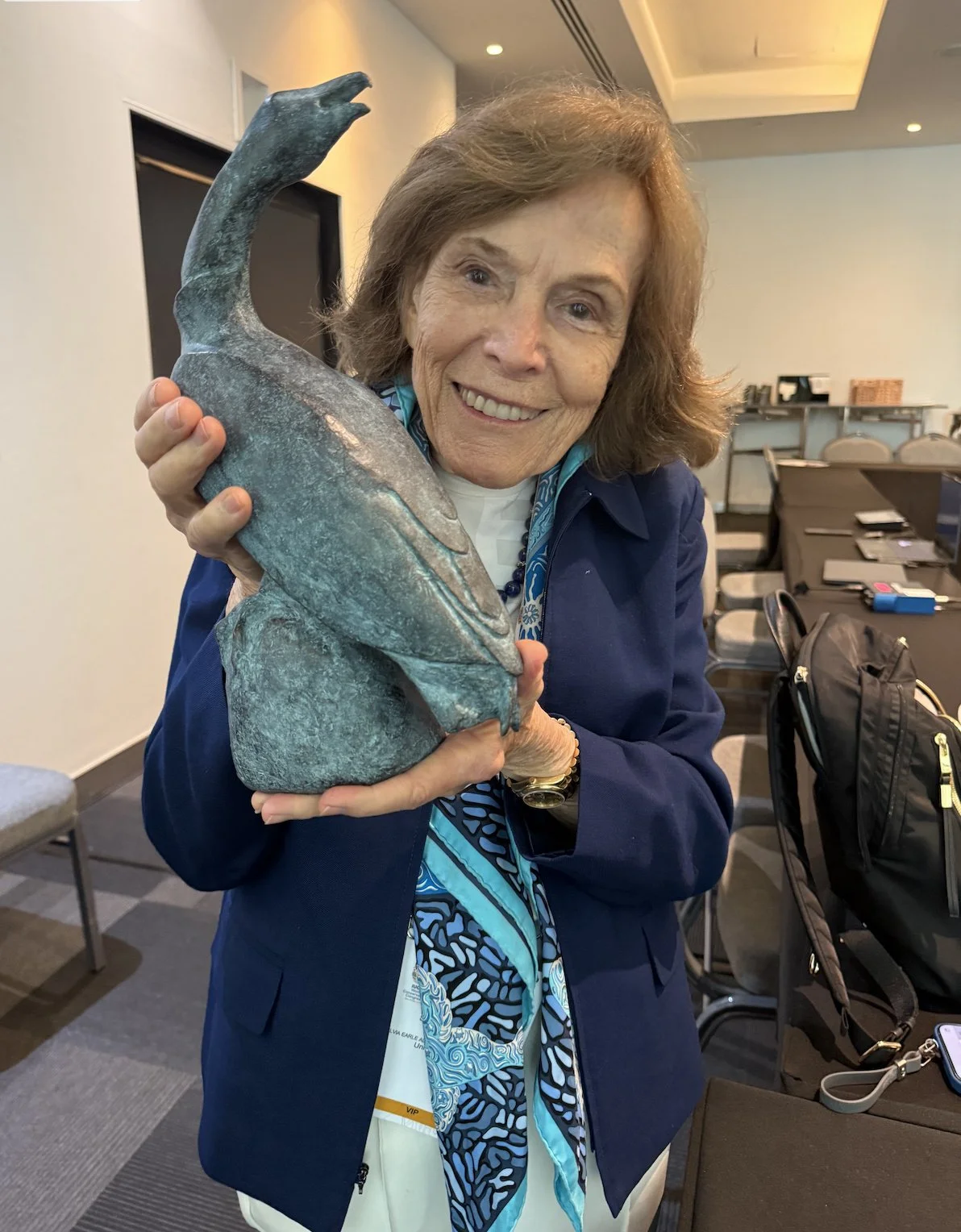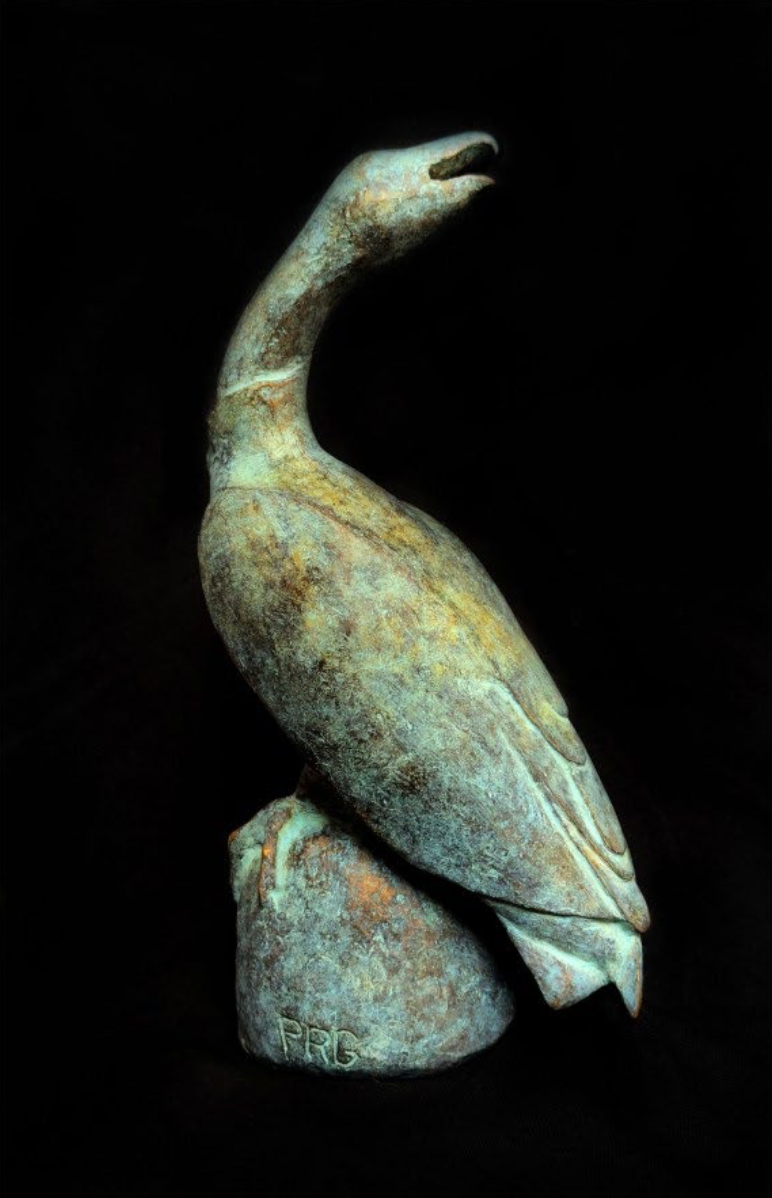
A friend and close colleague of mine for many years, Patricio Robles Gil is both a multi-talented  artist and a deeply committed conservationist. He is globally recognized for his accomplishments in both fields. You will see and hear more of him on WilderWork.org
Patricio developed the idea of a ‘Recognition’… not an ‘Award’… for a specific reason. The Order of the California Condor (OCC) is a personal, professional and a peer-to-peer recognition among a brotherhood/sisterhood of senior conservationists who have done extensive pioneering work. He invited me to join him in its mission.
As we continue to present this recognition in numerous countries and diverse settings --21 times, currently -- ‘something’ seems to happen almost every time. As we hand them the sculpture, we look them in the eye and say, with love and respect,  “We see you.” They receive and hold it tight, often caressing it, and often with moist eyes. Many times, they write to us later with short, heartfelt notes of how they look at it every day. The presentation is a ritual that enlivens and deeply touches everyone involved.
This Recognition is about committed work for nature over a lifetime, almost always with much personal sacrifice, and when we recognize our brothers and sisters in this work, it is a potent, emotional moment for all of us. .
Patricio explains the origin and mission:
The Order of the California Condor
“The Order of the California Condor emerges as an urgent, profound, and vital brother-sisterhood, born from the desire to recognize and honor those who have devoted their lives to the protection of the natural world. It rises as a response to the indifference of a society that still fails to grasp that its own survival depends on the health of the planet. It springs from an acknowledgment of the ignorance that renders species like the condor—living jewels of our natural history—almost invisible. It answers the need to forge symbols and emblems that, as in ancient times, inspire us to care for the Earth. And above all, it was born to give a face and a name to the new heroes of conservation. Our movement needs heros!
The sculpture, created by me, depicts the condor in defiance: it turns its long neck back and, with its beak slightly open, confronts us. It challenges us for our passivity, ignorance, indifference, arrogance, and greed. Its talons grip the rock and the earth tightly, symbolizing permanence and the millennia-old struggle against extinction.”
Since February 2025, some 21 recipients have been recognized, including George Schaller, Sylvia Earle, Russ Mittermier, Robert Bateman, Mavuso Msimang, Kristine Tomkins and more than fifteen other colleagues and friends who have dedicated their lives to the conservation of nature. (See a list of recipients below).
For more information on the Order of the California Condor as it resides on Patricio’s website. (click here for the OCC page and stay tuned for an OCC specific site coming soon)
LIST OF RECIPIENTS OF THE ORDER OF THE CALIFORNIAS CONDOR
1–2. Juan Vargas & Catalina Porras — Mexicans, Recipients on March 15, 2025. Mexico City.
Juan Vargas is a Mexican biologist with more than 40 years of continuous fieldwork, 23 of them dedicated to the recovery of the California condor in Mexico.
He has been the key member of the California Condor Recovery Program, contributing to one of the longest and most successful species restoration projects in the country.
Juan´s career exemplifies dedication, technical expertise, and long-term commitment to species conservation.
Juan Vargas is regarded as one of the most experienced condor field specialists in the world.Catalina Porras Together with Juan, she has been a central figure in the California Condor Recovery Program in Mexico, one of the most important conservation initiatives in North America.
Her work integrates science, wildlife management, and cross-border collaboration.
Porras has coordinated field operations for condor monitoring, reintroduction, and habitat protection, working closely with government agencies, scientists, and international conservation organizations.3. Vance G. Martin — USA, Recipient on March 15, 2025. Mexico City.
Vance G. Martin is a global leader in wilderness conservation and environmental policy.
He is the founder and former President of The WILD Foundation, one of the world’s leading organizations dedicated to protecting wilderness and wild nature.
For over 40 years, he was also the principal organizer of the World Wilderness Congress, the premier international forum for wilderness protection.
His field experience spans Africa, Latin America, Asia, and North America.
Vance pioneered global wilderness protection in the World Commission on Protected Areas (WCPA) of the IUCN.His career reflects a lifelong commitment to safeguarding the world’s remaining wild places, integrating cultural and artistic strategies for nature conservation, and promoting the importance of traditional cultures.
4. Anne Valer Clark — USA, Recipient on March 15, 2025. Mexico City.
Anne Valer Clark is a leading conservationist dedicated to the protection and restoration of desert ecosystems in the U.S.–Mexico borderlands. She is the founder and former director of the Malpai Borderlands Group and a key figure in cross-border conservation.
Valer´s work integrates science, land stewardship, and community-based conservation.
Clark has been instrumental in large-scale habitat restoration initiatives across the Chihuahuan Desert.
In Cuenca Los Ojos, she has led groundbreaking efforts in grassland, wetland, and watershed restoration. Her work there has become a model for binational conservation cooperation.
She is internationally recognized for her innovative leadership in landscape-scale conservation.5. José Sarukhán — Mexican, Recipient on June 20, 2025. Mexico City.
Dr. José Sarukhán is a distinguished Mexican ecologist and academic leader, and two-time Rector of the National Autonomous University of Mexico (UNAM).
He is one of Latin America’s most influential scientists in ecology and environmental policy. Sarukhán has played a central role in shaping Mexico’s national conservation and sustainability agenda.
His research career has focused on plant ecology and ecosystem dynamics. In Los Tuxtlas, Veracruz, he conducted pioneering studies on the structure and dynamics of tropical trees.
He is the founding National Coordinator of CONABIO (National Commission for the Knowledge and Use of Biodiversity). Dr. Sarukhán’s legacy bridges science, education, and public policy at the highest level.6. Robert Bateman — Canadian, Recipient on September 9, 2025. Salt Spring Island, Canada.
Robert Bateman is a world-renowned Canadian naturalist painter and environmental advocate. His artwork is celebrated for its scientific accuracy and deep respect for wildlife and wild landscapes.
For decades, Bateman’s paintings have helped shape public awareness of nature and conservation. His work has been exhibited in major museums and galleries around the world.
He is also an author and educator, promoting environmental ethics through art and outreach. Bateman has received numerous international honors for both his artistic and conservation contributions. He is considered one of the most influential wildlife artists of our time.7. Sylvia Earle — USA, Recipient in October 11, 2025 at the IUCN World Congress, Abu Dhabi, United Arab Emirates.
Dr. Sylvia Earle is one of the world’s most influential marine biologists and ocean explorers.
She is the founder of Mission Blue and a leading advocate for ocean conservation worldwide.
Earle has led more than 100 expeditions and logged over 7,000 hours underwater, including the deepest-untethered sea walk.
She served as Chief Scientist of the U.S. National Oceanic and Atmospheric Administration (NOAA).
Sylvia´s work has transformed public understanding of the importance of ocean ecosystems. She has received numerous international awards for science, exploration, and environmental leadership. Dr. Earle is an Explorer-at-Large for the National Geographic Society and is widely regarded as a global icon of marine conservation.8. Ramón Pérez Gil — Mexican, Recipient in October 11, 2025 at the IUCN World Congress, Abu Dhabi, United Arab Emirates.
Ramón Pérez Gil is a Mexican conservation biologist with a distinguished career in wildlife research and protection.
He has played an important role within the International Union for Conservation of Nature (IUCN), contributing to global conservation strategies and species assessments.
His work with IUCN has strengthened international collaboration on biodiversity conservation.
Pérez Gil has led and participated in major conservation projects throughout Mexico.
In Isla Cedros, he conducted extensive field research on the ecology and conservation of the endanger and endemic mule deer.9. Russell A. Mittermeier — USA, Recipient in October 11, 2025 at the IUCN World Congress, Abu Dhabi, United Arab Emirates.
Dr. Russell A. Mittermeier is one of the world’s leading primatologists and a global authority on biodiversity conservation.
A former VP of World Wildlife Fund, Russ is President Emeritus of Conservation International and currently serves as Chief Conservation Officer of Re:wild.
His scientific work has focused on primates, megadiversity regions, and global conservation priorities.
Mittermeier has conducted field research in more than 30 countries across the tropics.
He has authored over 300 scientific and popular publications on conservation and biodiversity.
He has advised governments, NGOs, and international organizations on conservation strategy. In 1998 he was named Time magazine’s Hero of the Planet 2012, he was recognized as a lifetime Honorary Member of the International Union for the Conservation of Nature (IUCN) and long-time Chair of the Primate Specialist Group.
His career has shaped modern conservation policy and practice worldwide.10. Laurie Marker — USA, (permanent Resident of Namibia), Recipient in October 12, 2025 at the IUCN World Congress, Abu Dhabi, United Arab Emirates.
Dr. Laurie Marker is a renowned conservation scientist and founder of the Cheetah Conservation Fund (CCF).
She has dedicated more than four decades to the study and protection of cheetahs in Africa. Her work integrates scientific research, habitat conservation, and community development.
Marker pioneered innovative programs for cheetah conservation, including mitigating human-wildlife conflict through community-based livestock management and education initiatives.
She has been at the forefront of the global fight against the illegal trafficking of cheetah cubs, where the trade poses a severe threat to the species’ survival.
She is both an expert field biologist and a world-ranked academic with many published papers, and has collaborated with governments, academic institutions, and international organizations worldwide.
Dr. Marker is widely recognized as one of the most influential figures in large carnivore and predator conservation.11. Azzedine Downes — USA, Recipient in October 12, 2025 at the IUCN World Congress, Abu Dhabi, United Arab Emirates.
Azzedine Downes is a global leader in wildlife conservation and President & CEO of the International Fund for Animal Welfare (IFAW).
He has dedicated his career to protecting animals and the habitats they depend on through policy, science, and community-based conservation.
Under his leadership, IFAW has expanded its global impact across more than 40 countries. Downes is recognized for revolutionizing the integration of animal welfare and nature conservation, and advancing innovative strategies, in rural development, and human well-being.
He has worked extensively with governments, international organizations, and local partners. His vision emphasizes sustainable solutions for both people and wildlife.
He is widely regarded as one of the most influential voices in contemporary global conservation.12. Martin Von Hildebrand —Colombia, Recipient in October 24, 2025, in México City.
Anthropologist, conservationist, and one of the most influential defenders of Indigenous peoples and Amazonian ecosystems in Latin America. Founder and former director of Fundación Gaia Amazonas, he has dedicated more than four decades to protecting Indigenous territories, cultures, and governance systems.
His work was instrumental in the legal recognition of millions of hectares of Indigenous land in the Colombian Amazon. A pioneer of biocultural conservation, he has promoted development models rooted in ancestral knowledge and environmental stewardship.
Von Hildebrand has advised governments, international organizations, and Indigenous councils across the Amazon Basin. His vision bridges anthropology, conservation, and human rights with profound ethical commitment.
His life’s work stands as a cornerstone of territorial defense and planetary responsibility.13. Felipe Ramírez — Mexican, Recipient on December 5, 2025. Mexico City.
Felipe Ramírez is a veterinarian and animal scientist whose pioneering fieldwork in the recovery of the pronghorn in Mexico is a benchmark for wildlife conservation and management in the country.
He is the creator of the Wildlife Management Units model (Unidades de Manejo para la Conservación de la Vida Silvestre — UMAs), which forms the foundation of modern sustainable-use policy in Mexico.
He served as Director General of Wildlife at Mexico´s (Secretaria de Medio Ambiente y Recursos Naturales, SEMARNAT), where his work integrated science, public policy, and community participation, playing a key role in the institutionalization of biodiversity conservation in Mexico.14. Rodrigo Medellín- Mexican, Recipient on Jauary 23, 2026. México City.
Rodrigo Medellín is a Mexican scientist and conservation biologist based at the Institute of Ecology of the National Autonomous University of Mexico (UNAM). He is internationally recognized as one of Mexico’s leading conservationists and a foremost expert on bats. His research has been instrumental in changing public perception of bats and highlighting their ecological importance. Medellín has led pioneering studies on bat ecology, conservation, and ecosystem services across Latin America. He has played a key role in protecting endangered species and critical habitats. As an Explorer-at-Large for the National Geographic Society, he has promoted science-based conservation worldwide. His work bridges science, policy, and public outreach..
15. Thomas D. Mangelsen — USA, Recipient in March 14, 2026 at the Crane Trust, Nebraska. USA.
Thomas Mangelsen is one of the world’s leading nature photographers, celebrated for his powerful images of wildlife in their natural habitats.
Mangelsen’s images emphasize both the beauty and fragility of the natural world.
He has traveled to every continent in pursuit of documenting Earth’s most remarkable wildlife. Over his career, he has published numerous books and opened galleries across the United States. His work has played a significant role in raising awareness about conservation and endangered species.
He founded the Cougar Fund to help protect mountain lions across the Americas.
Recognized by Nikon as a “living legend,” his influence extends across generations of photographers.16. Jack Dykinga — USA, Recipient in March 31, 2026 at the Etherton Gallery in Tucson. USA.
Jack Dykinga is an American photographer renowned for his striking large-format landscapes of the American Southwest.
He began his career as a photojournalist at the Chicago Sun-Times. In 1971, he earned a Pulitzer Prize for Feature Photography for his coverage of civil unrest.
He later transitioned to fine art photography, focusing on deserts, canyons, and fragile ecosystems. His work spans regions such as Arizona, Baja California, and the Sonoran and Chihuahuan deserts. In Mexico, he documented stories along the US–Mexico border and the Laguna Madre. He also worked in southern states like Chiapas and Yucatán, supporting numerous NGOs.
His photographs have been widely exhibited and published internationally. Through his work, Dykinga highlights the beauty and vulnerability of arid landscapes and indigenous lands.
17. Kristine McDivitt Tompkins — USA, Recipient on May 5, 2026 in Santa Paula, CA, USA.Kristine McDivitt Tompkins is the president and co-founder of Tompkins Conservation. She is an American conservationist and former CEO of Patagonia, Inc.
For over three decades, she has committed to protecting and restoring key ecosystems and biodiversity by creating national parks, bringing back wildlife, seeding activism, and creating economic vitality.
Kristine and her late husband, Douglas Tompkins, helped create or expand 16 parklands, protecting over 16 million acres in Chile and Argentina, as well as three marine protected areas totaling over 31 million acres, a legacy that continues through the now-independent offspring organizations, Rewilding Argentina and Rewilding Chile. Considered the foremost conservation philanthropists in history, the couple’s story is told in Wild Life, a film by Oscar-winning directors Jimmy Chin and Chai Vasarhelyi.
18 . Fulvio Eccardi --- Italy, Joined in August 2, 2026, Mexico City
Fulvio Eccardi is a biologist and photographer, 50 years documenting the cultural and natural wealth of Mexico. Former editor of Biodiversitas, CONABIO´s newsletter. With numerous exhibits in Canada, Mexico, Italy and USA. In 2003 he inaugurated the first ever exhibition on the gates of the Chapultepec Park in Mexico City visited by millions. Other exhibits include the “Golden Eagle”, “Cloud Forest, coffee and quetzal”. His photographs have been published in magazines, has authored and edited books on nature and has directed more than 300 videos. Along his career he formed an archive of over one million photographs. He has served as advisor to the Institute of Natural History of Chiapas, Conservation International, World Wildlife Fund, The Nature Conservancy, Pronatura and the Mexican Fund for Nature Conservation. Helped with the communication strategies for Chicza (natural chewing gum producer), the Forestry Stewardship Council and others. Founding President and member of the El Triunfo Conservation Fund (Reserve he helped establish) and of the Mexican Fund for Environmental Education and Communication.
19 . Mavuso Msimang -- South Africa, Joined on August 27, 2026, Johannesburg.
Mavuso Msimang was in exile from the South African apartheid government for many years, during which time he was a senior member of the African National Congress and served on the Military High Command of Umkhonto weSizwe (MK). In 1977 he joined the United Nations, working in Zambia, Kenya and Ethiopia. He subsequently worked for the World University Service of Canada (WUSC) and CARE International in Ethiopia and Kenya. He earned his MBA from the International University in California. He returned to South Africa in 1993 and was instrumental in nature protection and nature tourism, serving in a number of positions including Executive Director of South African Tourism, CEO of South African National Parks (SANParks) and CEO of the State Information Technology Agency. He was a driving force in reorganizing and making SANParks a highly respected conservation organization. Mavuso was one of the original founders of African Parks and served on the boards and programmes of numerous national and regional conservation NGOs, including Wilderness Foundation Africa.
20. Eric Hagsater
21. George Schaller